
Negotiating Your Position

The seller wants the most for their home and the buyer wants to pay the least possible.  From the very beginning of the home buying process, there are adversarial positions between the principals.  If you happen to be in a multi-offer situation, it just complicates things further.

Then, there are the emotions that tend to cloud the decision making on both sides of the transaction.  Sellers have lived in the home for years, possibly, with cherished family experiences and maybe, having put considerable effort and money into capital improvements.

On the buyer side, they may have lost out on several homes due to competing offers and now, this year, interest rates have doubled, and the discretionary funds required to pay for a home could be causing cuts in their budget in other areas.

A year ago, buyers were waiving contingencies for financing, appraisals, inspections, and other things just to be competitive.  Today, to make the home more affordable with the higher mortgage rates, buyers need the seller to make financial concessions but who is going to make their case to the seller for them?

The role of a third-party negotiator played by the real estate professionals has always been valuable to the success of the transaction but now, it may even be essential.  Sellers enjoyed an extraordinary market in their favor for the past two years with incredible appreciation and so many buyers chasing so few homes, the sellers were able to write their own ticket.

Inflation and mortgage rates have put the brakes on the market, eliminating over 15 million mortgage-ready buyers.  The buyers who are still in the market need to be cautious, so they don’t overextend themselves and overpay for a home.

The agents can assist both the buyers and sellers in seeing things in an objective way that reflects the current market and not the way it was a year ago.  All parties must be reasonable and not expect too much.  They need to consider facts and not feelings.

Negotiating the sale or purchase of a home is a competition; for one person to get something, someone must give something up.  If a person doesn’t feel comfortable with this, it is important to work with an agent who can bring their skills to the table on your behalf.  As your advocate, they can champion your position and put transactions together that would not have been possible if it were left to the principals alone.

Negotiation skills are acquired through training and experience.  When interviewing an agent, ask them what role negotiation plays in their marketing plan if you’re a seller and purchase plan, if you are a buyer.  An agent who cannot defend their position in the transaction may not be the right person to defend yours.

Gary Thompson
CRS, SRS, SFR, e-Pro, Broker Associate
Masters Utah Real Estate
(801) 821-9292
5486604-AB00
Contact Me Visit Website Subscribe to Newsletter

“Do you feel lucky? Well, do ya?”

You may remember the famous line in the Dirty Harry movie when Clint Eastwood has just had a shootout with bank robbers and is standing in front of the lone surviving thief who is considering going for his gun. Harry with his gun pointed at the bad guy says to him “”Did he fire six shots or only five? Well, to tell you the truth, in all this excitement, I kinda lost track myself. But being this is a 44 Magnum, the most powerful handgun in the world and would blow your head clean off, you’ve gotta ask yourself one question: Do I feel lucky? Well, do ya?” 

Our economy has had a long recovery from the great recession, due in most part to the housing crisis of 2007-2009.  Then, the Pandemic hit in 2020 which tanked the worldwide economy but the surprise to homeowners happened to be housing.  2021 became a red-hot market with prices going up by 21% nationally. 

In 2022, mortgage rates have increased by four percentage points and haven’t been this high since 2008.  Inflation, at the end of September, reached a 40-year high at 8.2%.  The Fed recently said they’ll continue raising rates until they can get inflation near their target of 2% annual rate.

People who own homes have seen their values go up dramatically and so has their net worth. Due to the extremely low inventories and the maturing millennial market, there is a lot of pent-up demand for housing.

This leads us to the scene in the movie.  You may be considering buying a house now but at the same time, you’re thinking “Have prices and mortgage rates hit the top of the market so they’ll start coming down or will they continue to go up, making it cost more to get into a home?”

The facts are that the U.S. is the strongest economy in the world.  The housing bubble of 2007 was created by over-inflated property values and predatory lending practices.  Those conditions don’t exist today.  There is a housing shortage in America due to not enough homes being built to keep up with demand and people staying in their homes longer.

Homeowners have record amounts equity in their homes and foreclosure rate hit a historic low at the end of 2021 even though it edged up a bit in spring of 2022 as reported by CoreLogic.

Homes are expected to continue to appreciate but not as fast as they did in 2021.  The revised predictions for 2022 appreciation vary from Fannie Mae at 16%, Freddie Mac at 12.8% to NAR at 11.5%.

NAR Senior Economist Nadia Evangelou recently said “Mortgage rates are a heartbeat away from the 7% threshold. According to Freddie Mac, the 30-year fixed mortgage rate rose to 6.92% from 6.66% the previous week. While inflation remains elevated, mortgage rates will continue to move up, making homeownership even further out of reach for many.”

If the home you could buy this year for $500,000, will cost you $550,000 next year and the mortgage rate goes up from 6.5% to 7.5%, the payment will go from $2,844 to $3,461 based on a 90% mortgage for 30-years.

If interest rates are temporarily high based on the Fed’s position to lower inflation, a home could be purchased at today’s price and refinanced later when the rates come down.  5/1 adjustable rate mortgages allow a borrower to lock in a lower initial rate for five years which would allow a person to find the best time to refinance.

So, back to the movie scene… “you’ve gotta ask yourself one question: Do I feel lucky? Well, do ya?” 

Gary Thompson
CRS, SRS, SFR, e-Pro, Broker Associate
Masters Utah Real Estate
(801) 821-9292
5486604-AB00
Contact Me Visit Website Subscribe to Newsletter

Another Tool to Improve Affordability

The rapid rise in mortgage rates during 2022 coupled with continued appreciation of home prices have limited the number of buyers in the market which is reflected by the lower number of home sales currently.  “It’s a fact that many households are impacted by higher mortgage rates as they no longer earn the qualifying income for the median-priced home.” Nadia Evangelou, NAR Economist

One of the things that agents are doing to help buyers lower their house payments is to suggest an adjustable-rate mortgage.  The rates on these types of loans are tied to indexes that reflect the current market rates and produce less risk for the lender.  The payments adjust on the anniversary date based on the index plus margin named in the note.

While many people think that they only adjust upward, they also adjust downward when the index indicates it.  For the week of September 29, 2022, the Freddie Mac 5/1 ARM was 5.03% compared to the 30-year fixed-rate of 6.70%.

Another tool that experienced agents are using to address affordability issues are interest rate buydowns.  In recent years, there have not been many buydowns used because interest rates were already very low, but now, more people are considering them again.

A buydown is prepaying the interest on a mortgage at the time of closing to lower the payment for a specific period or for the term of the mortgage.  Obviously, it would be more expensive to buydown the rate for the whole term of the mortgage.

Either the seller or the buyer can buydown the rate and it would be specified in the sales contract.  From a practical perspective, sellers in the recent past haven’t had to consider this option because of the high demand and multiple offers that were commonplace.  Now that sales have slowed, and both inventory and market time is increasing, some sellers want to make their homes more marketable and are seeking a competitive advantage.

A common temporary buydown is called a 2/1 which reduces the payment in the first two years of the loan by calculating the borrower’s payment at 2% less than the note rate for the first year and 1% less than the note rate for the second year.  Years three through thirty, the payment would be the normal payment at the note rate.

A buydown is a fixed rate, conforming mortgage that the borrower must qualify at the note rate to indicate that borrowers will be able to afford the mortgage after the first two years of lower payments.

As an example, on a $4000,000 sales price with a 90% mortgage at 5.54% interest for 30-years, the normal principal and interest payment would be $2,053.08.  By using a 2/1 buydown, the payment for the first year would be at 3.54% interest, 2% lower than the note rate, making the payment $1,624.61.  The second year, it would be at 4.54% interest, 1% lower than the note rate, making the payment $1,823.63.

The buyers’ payment would be $428.47 lower each month for the first year and $220.45 a month lower for the second year.  The total savings would be $7,787.04 which becomes the cost of the 2/1 buydown.  This amount must be paid at the time of closing by either the seller or the buyer.

2/1 Buydown Example1st Year2nd Year3rd … 30th Years
Interest Rate4.7%5.7%6.7%
Principal & Interest Payment$1,867.10$2,089.44$2,323.00
Monthly Savings$455.90$233.56 
Annual Savings/Total Savings$5,470.80$2,802.72$,8,273.52

The most prevalent providers of buydowns in the past have been builders.  It is a concession like paying closing costs or upgrades for the buyer.  As sales have started to slow, some builders in particular price ranges and areas are currently considering this benefit to close more sales.

To summarize: a buydown is a fixed-rate mortgage where the interest is pre-paid for a period to help the borrower with lower payments for a time.  A 2/1 buydown allows the buyer to have significantly lower payments in the first two years which will give them time to settle into the house while they can be confident of what the payment will be in years three through thirty.

The pre-paid interest is deductible for the buyer, even if the seller pays for it.  This is something that the buyer will want to talk about with their tax advisor when they are doing their income tax for that year.

If you are selling a home, talk to your listing agent about this option to increase marketability.  If you are a buyer, discuss this as an affordability option.  If your agent isn’t familiar with buydowns, ask them to research it with a trusted mortgage officer.  Buydowns are legal and have been available for decades.  The determining factor may be whether the market has softened enough that sellers are willing to consider them.

Gary Thompson
CRS, SRS, SFR, e-Pro, Broker Associate
Re/Max Masters
(801) 821-9292

5486604-AB00

Contact Me Visit Website Subscribe to Newsletter

When are the Negotiations Over?

The primary negotiation in a home purchase takes place when the contract is agreed upon that including the price, closing, and possession.   With inventory down over 19% in the past year and multiple offers being more of the norm than the exception, the first round of negotiations can be challenging.

Buyers and sellers alike feel relieved once it has resulted in an agreement, but experienced agents know there is more to come if there are contingencies for financing, inspections, or other things.  The competition for the home may be so tough that the buyer waived their rights for what would be normal contingencies.

Financing is one of the most common contingencies in normal situations but when multiple offers are involved, the cash offers tend to have the advantage.  If you don’t have the resources to make a cash offer, the next best position is to be pre-approved with a commitment letter from the lender.  Arrange for the lender to confirm the pre-approval directly with the listing agent prior to the listing agent presenting the offer.

There have been buyers who know they don’t have the cash to close and apply for a mortgage anyway and try to reinsert the provision outside of the contract.  Experienced listing agents will advise the seller to have the buyer provide proof of funds necessary to close and verify that they do indeed exist.

The purpose of an inspection is for the buyer to receive an objective evaluation of the condition of the home and its components to identify existing defects and potential problems.  The expense for inspections can be several hundred dollars and it’s reasonable for buyers not to want to spend the money before they find out if they can come to terms with the seller.  From a different perspective, sellers want to know quickly if the buyer is going to reject the home due to the inspections because they could be losing time.   For that reason, inspection time frames are limited to a few days from acceptance of the offer.

Sometimes, buyers will expect sellers to make all the repairs listed on the report and this is where the second round of negotiations begins. If the seller refuses, the negotiations can go back and forth until the other party accepts the offer on the table.

When purchasing a new home from a builder, it is expected for everything to be in working order; after all, it is new.  However, it is reasonable to expect that existing homes, that are not new, have a different standard.  While it’s understandable that buyers would want to be aware of major items that are not in “working order”, normal wear and tear of components based on their age should be expected.

In a highly competitive seller’s market, buyers might do whatever they can to get their contract accepted, realizing that there is another place to negotiate when they’re not competing with other buyers’ offers to purchase.

The negotiations involved in a home purchase are not complete until the buyer and seller have signed the papers and the title has passed to the buyer.  Up until the closing is finished, any item that comes up could prolong the negotiations.

For this to be a WIN-WIN situation, both seller and buyer must feel good about the negotiations that led to the transaction closing.  Neither party should feel that the other party had an unfair advantage over them.

Gary Thompson
CRS, SRS, SFR, e-Pro, Broker Associate
Re/Max Masters
(801) 821-9292

5486604-AB00

Contact Me Visit Website Subscribe to Newsletter

You don’t have to give an arm to get a lower rate

Rising interest rates compounded with increasing home prices are causing affordability issues for many buyers.  To keep payments low, you won’t have to give an arm, but more buyers are considering getting an ARM, adjustable-rate mortgages.

Mortgage rates are near their highest point since 2009.  “While housing affordability and inflationary pressures pose challenges for potential buyers, house price growth will continue but is expected to decelerate in the coming months,” said Sam Khater, Freddie Mac’s Chief Economist.

A $400,000 home with a 10% down payment and a 30-year term has the choice of a 5.27% fixed rate or 3.96% for a 5/1 adjustable-rate mortgage.  The principal and interest payment will be $1,992.40 for the fixed rate and $1,710.40 for the adjustable-rate saving the buyer $281.99 per month for five years.

There is an additional saving for the buyer choosing the adjustable-rate mortgage because the unpaid balance at the end of the five-year first period is $6,429 less than the fixed rate.  The total savings to the buyer on the adjustable-rate during the first period is $23,348 or $389.13 per month for sixty months.

At the end of the first period, the rate on the mortgage can adjust according to the then, current index plus the margin subject to the caps as specified in the note.  These safeguards remove control from the lender or servicer from arbitrarily raising the rate.

The caps restrict the payments from going up more than a certain amount at each period or overall, for the life of the mortgage.  A common cap might be that it cannot adjust more than 2%, up or down, at any given adjustment period or 6% above or below the initial note rate.

Adjustable-rate mortgages must adjust downward if the index indicates a reduction at the anniversary of the adjustment period.  The overall trend has been lower rates for the past thirty years until recently.

Using an Adjustable Rate Comparison tool, you can project a breakeven point to determine at what point the ARM would be more expensive than the fixed rate, assuming a worst-case situation where the rates would increase the maximum at each period.

In the case of the previous example, the breakeven would occur at 7 years and 6 months.  This means that if the buyer were to sell the home prior to that projection, the ARM would provide the cheapest cost of funds to purchase the home.  On the other hand, if the buyer knew they would stay longer than that, it might be a safer option to go with the fixed rate.

It is good to be aware of available options when financing a home.  Analyzing, and using the best information available, can help you make an informed decision.  Make your own comparison using our ARM Comparison.  Current interest rates can be found on Freddie Mac.

Gary Thompson
CRS, SRS, SFR, e-Pro, Broker Associate
Re/Max Masters
(801) 821-9292

5486604-AB00

Contact Me Visit Website Subscribe to Newsletter

Coordinating the Sale and Purchase of Your Home

Usually, it is easier to buy a home than to sell a home but that isn’t necessarily the case currently. In today’s market, it can be scary to sell your home before buying another because you could find yourself without a home.

Most sellers will not accept a contingency on the sale of a buyer’s home in today’s market.  So, let’s look at some of the alternatives that homeowners are using to facilitate the transactions. 

If you have the income, credit, and cash available, the replacement home can be purchased with a new 80-90% loan-to-value mortgage and sell the existing home after you have moved into the new home.  This would require making two payments for a while but probably gives the seller the least amount of pressure to find the replacement property before the existing one is put on the market.

If the mortgage on the new home has the option to recast the payment, additional down from the equity in the previous home after it sells would lower the payments without causing any additional expense to refinance.

Another alternative may be available if your home has enough equity to borrow against it in a Home Equity Line of Credit or a bridge loan.   This type of loan is generally made by banks who will loan qualified owners up to 80% of the appraised value less the current mortgages on the property.  Freeing up the equity in your existing home will give you a down payment for purchasing the new home before you sell the previous one.

If a seller has assets in qualified retirement programs, it is possible to do temporary loans against them to facilitate the interim purchase.  There can be penalties on some of these if they are not repaid in a timely manner.  It would be good to investigate with your tax professional to see if this is a viable option.

Hard money lenders provide a source that will be more common to investors than homeowners.  These types of loans are generally approved and funded quickly, have less requirements than bank loans and provide funding for projects that cannot be financed elsewhere.  Interest rates are higher than bank loans, are written for short terms (1-2 years), and usually require 25-30% down payment or equity.

Power Buyers and iBuyers offer to purchase your home for cash and provide a quick closing.  Deeper investigation into these options may reveal that you will not receive the full equity of your home because they have to discount the home to cover the expenses they will incur as a seller.    

In today’s very complicated market, the value of a real estate professional representing your best interests, providing you advice, options and experience has never been greater.  While there are similarities in transactions, each one is unique, and you certainly need a professional to be guiding you through the process.Agents are trained and experienced in coordinating the purchase and sale of homes.  This can be especially beneficial in navigating unfamiliar waters.

Gary Thompson
CRS, SRS, SFR, e-Pro, Broker Associate
Re/Max Masters
(801) 821-9292

5486604-AB00

Contact Me Visit Website Subscribe to Newsletter

A New Opportunity for Homebuyers

You may not have heard of anyone assuming an existing mortgage for over thirty years and didn’t know they were even possible any longer.  The reason is simple, it didn’t make financial sense but now that interest rates are increasing, it may be an opportunity for some homebuyers.

Conventional loans added clauses to mortgages back in the early 80’s that gave the noteholder the right to raise the interest rate if a loan was assumed, as well as require the new buyer to qualify for the loan.  This essentially ended the practice of assuming conventional mortgages.

Then, in the late 80’s, FHA and VA mortgages did impose the right to qualify the new buyers, but the big difference was that the mortgage rate would remain the same as the original borrower.  Even so, it still effectively ended the assumptions of FHA and VA mortgages because rates on mortgages trended down for the next thirty years.

There was really no benefit to assume a mortgage that still required qualifying because it was possible to obtain a new mortgage with a lower rate.  Generations of buyers have never even contemplated assuming a mortgage but now, in 2022, it might well be an alternative that will lower the cost of buying a home.

Mortgage rates hit a bottom in early 2021 and have been increasing since, this year especially. 

Since qualifying is required for assuming an FHA or VA mortgage and only owner-occupants are eligible, you might be asking what are the benefits?  If the interest rate on the existing mortgage is less than the rate on a new mortgage, there could be a savings.

In addition to that, there are fewer closing costs involved on assumptions of FHA and VA mortgages than originating new mortgages.  Another benefit is that assuming an existing mortgage will be further into the amortization schedule than a new one which means equity-buildup occurs faster.  And finally, lower interest rate loans amortize faster than higher rate loans.

The rub in this situation is that many buyers don’t have enough money to purchase an equity but there is a remedy for that.  Let’s assume the buyer was considering a 90% conventional loan.  If they identified a home with an assumable mortgage, they could put the same 10% down payment in cash, subtract the existing mortgage balance from what would be the 90% new mortgage and secure a second mortgage for the difference.

There are lenders that make this type of loan and buyers need to shop and compare rates and fees on them just like they would if they were getting a new first mortgage.  Your agent can suggest lenders for second mortgages.

Most search filters on portal websites do not include assumable mortgages.  You will need to rely on your agent to ferret them out.  If the agent you are working with hasn’t suggested assumptions, it may be that they are unaware of their existence.

Gary Thompson
CRS, SRS, SFR, e-Pro, Broker Associate
Re/Max Masters
(801) 821-9292

5486604-AB00

Contact Me Visit Website Subscribe to Newsletter

Assumptions Make Sense Again

Existing FHA and VA mortgages are assumable at the note rate to owner-occupied buyers who qualify.  This can be an alternative to paying higher, current rates and benefit buyers with lower closing costs while saving money on the payment.

For the last 20 years, rates have been steadily coming down and there was no reason to qualify for the assumption when a new loan had a lower interest rate.

Assuming an FHA or VA loan with a lower interest rate will obviously mean lower payments but it will also build equity faster because the amortization schedule is advanced from a new 30-year mortgage.  Another benefit is that the acquisition costs on an assumption are much lower than starting a new loan.

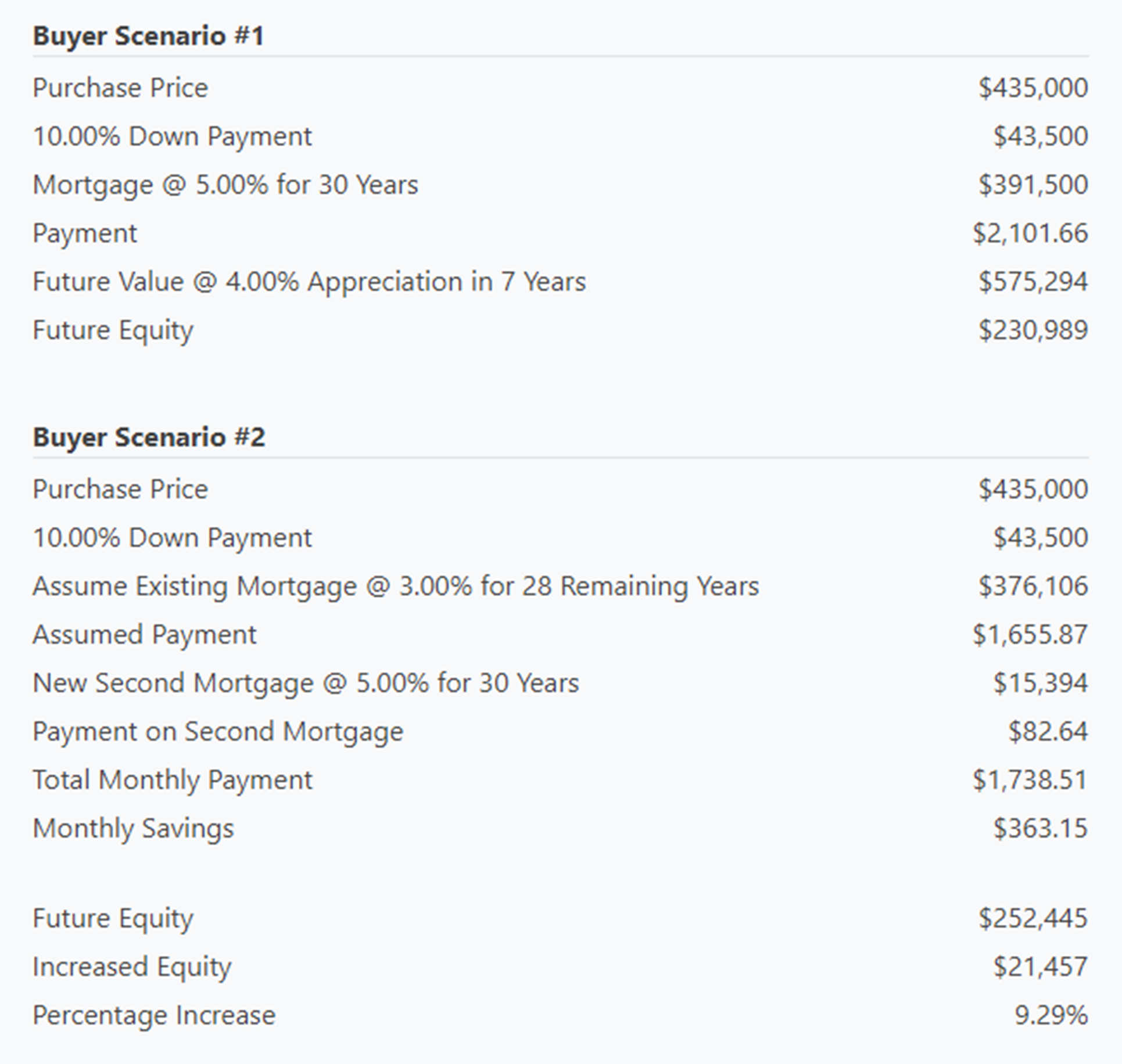
In the example in Table One, a couple bought a home two years ago for $400,000 with a 3% FHA mortgage that has principal and interest payments of $1,656.  It is now worth $435,000.

Let’s look at a hypothetical situation involving the sale of this home after two years.  The savvy listing agent explains that the home may have additional marketability due to the assumability of the FHA mortgage in place.

In scenario #1, the buyer purchases it for $435,000 with 10% down payment at the then, current rate of 5% for 30 years.  The principal and interest payment is $2,102.  If the home appreciates at 4% annually the equity will be $230,989 in seven years.

In scenario #2, the buyer purchases it at the same price with the same down payment but assumes the 3% mortgage with 28 years remaining.  Since he doesn’t have enough cash to buy the equity, he gets a second mortgage for the balance at 5%.  The combination of the payments on the first and second are $1,739 or $363 less than the payments in scenario #1.

In seven years, the $363 savings accumulated to $30,492.  The future equity is $21,457 larger on the assumption because the first mortgage is at a lower rate and the loan is amortizing faster.  In this example, the buyer is much better off assuming the FHA mortgage.

There will be a challenge in identifying which homes for sale have assumable FHA or VA mortgages because for decades it didn’t make much difference to list it in the description.  Many MLS’s are not even including fields for existing mortgages.

Finding the “Right” home for a buyer is important but equally important is finding the “Right” financing.  Not all agents have the training or the tools to identify the possible opportunities for buyers but the ones who do are invaluable.

Gary Thompson
CRS, SRS, SFR, e-Pro, Broker Associate
Re/Max Masters
(801) 821-9292

5486604-AB00

Contact Me Visit Website Subscribe to Newsletter
In Search of a Big Mortgage – 12/8/2021

The Fannie Mae and Freddie Mac loan limits are adjusted annually to keep up with cost of living but with the appreciation experienced in many markets, it may not be enough. When the conforming loan limit is not enough, qualified buyers can turn to a jumbo loan.

The maximum loan limit on conforming, conventional loans for 2022 is $625,000 for a single-family home but is increased up to $937,500 for designated high price areas.  The underwriting guidelines for conforming loans are consistent with regards to things like minimum down payment, private mortgage insurance, debt-to-income ratio, minimum credit score and cash reserves required.

Jumbo loans are loans more than the FNMA maximum limits and are considered non-conforming loans.  This allows lenders to set their own requirements on maximum loan amount, minimum required credit score, maximum debt-to-income ratio, and minimum down payment.

The rates paid on the jumbo loans may be the same as conforming loan rates.  It might sound logical that a larger loan would have more risk and therefore, be priced higher.  Lenders do not sell jumbo loans to FNMA which saves them the guarantee fee normally required.    This makes the jumbo loan more profitable.  Borrowers are encouraged to shop the rates. 

A minimum credit score of 700 will probably be required together with a debt-to-income ratio below 45%.  While many borrowers seeking a jumbo may be putting 20% down, it is possible to find a lender who may only require 10% down payment.  Lenders may be more lenient with regards to mortgage insurance.

Lenders may also require six to twelve months of cash reserves due to the increased risk of the larger loan amount.

It is a common practice for banks to make jumbo loans to attract other business that the borrower might be able to influence like company, corporate, or investment accounts.

Gary Thompson
CRS, SRS, SFR, e-Pro, Broker Associate
Re/Max Masters
(801) 821-9292

5486604-AB00

Contact Me Visit Website Subscribe to Newsletter

Cash-Out Refinance

With the rapid appreciation that homes have had in the last two years, most homeowners have equity.  A common way to release part of the equity is to cash-out refinance but some homeowners may not be eligible currently.

This type of loan replaces the current mortgage by paying it off and an additional amount of cash for the owner.  Generally, lenders will consider a new mortgage up to a total of 80% of the current value.

Typically, the rate on a cash-out refinance will be slightly higher than a traditional purchase money mortgage.  As is in any lending situation, the rate depends on the borrower’s credit and income.  The best interest rates are available to borrowers with higher credit scores, usually over 740.

Loan-to-value can affect the rate a borrower pays also.  A 70% loan-to-value mortgage could be expected to have a lower interest rate than an 80% LTV because there is a larger amount of equity remaining in the property and therefore, less risk for the lender.

There are no restrictions on how the owner can use the money.  It can be used for home improvements, consolidating debt, other consumer needs or for investment.

Eligibility Requirements as found in FNMA Selling Guide B2-1.3-03 Cash-Out Refinance Transactions

“Cash-out refinance transactions must meet the following requirements:

  • The transaction must be used to pay off existing mortgages by obtaining a new first mortgage secured by the same property or be a new mortgage on a property that does not have a mortgage lien against it.
  • Properties that were listed for sale must have been taken off the market on or before the disbursement date of the new mortgage loan.
  • The property must have been purchased (or acquired) by the borrower at least six months prior to the disbursement date of the new mortgage loan except for the following:
    • There is no waiting period if the lender documents that the borrower acquired the property through an inheritance or was legally awarded the property (divorce, separation, or dissolution of a domestic partnership).
    • The delayed financing requirements are met. See Delayed Financing Exception below.
    • If the property was owned prior to closing by a limited liability corporation (LLC) that is majority-owned or controlled by the borrower(s), the time it was held by the LLC may be counted towards meeting the borrower’s six-month ownership requirement. (In order to close the refinance transaction, ownership must be transferred out of the LLC and into the name of the individual borrower(s). See B 2-2-01, General Borrower Eligibility Requirements (07/28/2015) for additional details.)
    • If the property was owned prior to closing by an inter-vivos revocable trust, the time held by the trust may be counted towards meeting the borrower’s six-month ownership requirement if the borrower is the primary beneficiary of the trust.
  • For DU loan case files, if the DTI ratio exceeds 45%, six months reserves is required.”

Let me know if I can be of any help! Sincerely, Gary

Gary Thompson
CRS, SRS, SFR, e-Pro, Broker Associate
Re/Max Masters
(801) 821-9292

5486604-AB00 Contact Me Visit Website Subscribe to Newsletter